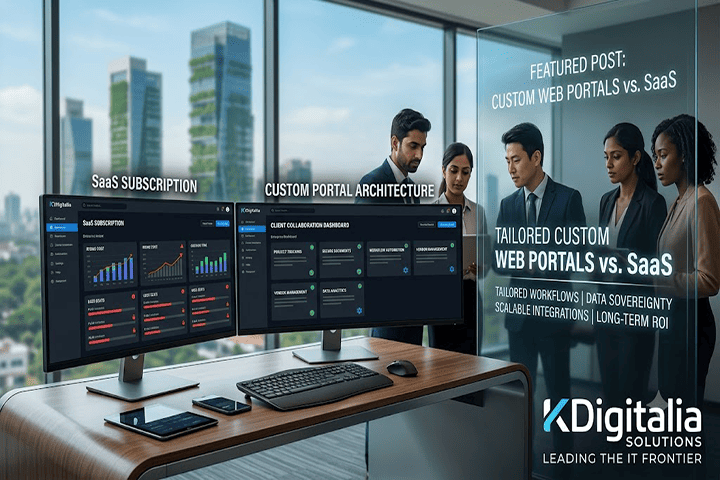
Custom Web Portals vs. Ready-Made SaaS: Strategic Guide
Custom Web Portals vs. Ready-Made SaaS: Which is Right for Your Business?
As modern organizations scale, managing client collaboration, internal workflows, vendor relationships, and fragmented data systems becomes increasingly complex. Relying on disconnected spreadsheets, email chains, or generic third-party software often introduces operational bottlenecks, data silos, and user frustration.
Business leaders and IT managers inevitably face a crucial strategic dilemma: Should you subscribe to an off-the-shelf Software-as-a-Service (SaaS) product, or invest in custom web portal development?
While subscription-based SaaS tools offer rapid deployment, custom web portals deliver tailored operational workflows, complete data sovereignty, and superior long-term financial ROI. Selecting the right path requires evaluating your business architecture, security compliance needs, and 3-to-5-year budget projections.
What is Custom Web Portal Development?
A custom web portal is a secure, web-based software application engineered to provide personalized access to specific data, tools, and processes for distinct user groups—such as clients, employees, suppliers, or channel partners.
Unlike standard public-facing marketing websites, custom enterprise portals function as centralized operational engines. Common portal types include:
B2B Client Portals: Enable self-service account management, real-time project tracking, secure document exchange, and automated invoicing.
Enterprise Employee Portals (Intranets): Streamline internal communications, HR workflows, task assignment, and knowledge management.
Vendor & Partner Portals: Simplify supply chain logistics, inventory updates, purchase order management, and partner compliance.
Custom E-Commerce & Service Portals: Facilitate complex B2B ordering, volume pricing tiers, custom cataloging, and subscription management.
The Hidden Drawbacks of Off-the-Shelf SaaS Solutions
Off-the-shelf SaaS platforms (such as Salesforce, HubSpot, or industry-specific portal software) promise quick setup and minimal upfront effort. However, as business requirements evolve, off-the-shelf solutions frequently encounter significant friction points:
1. The "Subscription Tax" and Escalating Per-Seat Costs
Most SaaS platforms monetize based on active user counts or transaction tiers. As your workforce, client base, or dataset expands, annual license renewals compound rapidly—turning a once-cheap tool into an exorbitant recurring expense.
2. Rigid Workflows and Feature Bloat
Off-the-shelf software is engineered for the "average" company. You end up paying for dozens of bloated features your team never uses, while essential, company-specific workflows require clunky workarounds or remain completely unsupported.
3. Vendor Lock-In and Limited Data Sovereignty
When your core operations run on proprietary SaaS infrastructure, exporting your raw data or migrating to another tool becomes challenging. Furthermore, you remain at the mercy of the vendor's price hikes, feature deprecations, and downtime schedules.
Key Advantages of Custom Web Portal Development
Building a custom enterprise web portal turns software into a permanent, scalable business asset designed around your exact operational blueprints.
1. Tailored Workflows & Intuitive User Experience (UX)
A custom portal adapts to your existing business processes—not the other way around. Role-specific dashboards, automated approval hierarchies, and customized user interfaces ensure higher employee adoption rates and seamless customer interactions.
2. Total Data Ownership, Security & Regulatory Compliance
For businesses handling proprietary financial records, legal documentation, or sensitive customer data, custom architecture provides complete control over encryption standards, server hosting locations, and compliance frameworks (such as GDPR, HIPAA, or SOC 2).
3. Deep Integration with Legacy Systems & Enterprise Tech Stacks
Custom web portals integrate natively via RESTful APIs, GraphQL, or enterprise service buses with existing back-office systems—including ERPs (SAP, Oracle, Microsoft Dynamics), CRMs, accounting software, and custom databases—eliminating manual data re-entry.
4. Unlimited Scalability and Modular Upgrades
Because you own the source code, your engineering team can incrementally roll out new feature modules, integrate artificial intelligence models, or scale server capacity as market demands shift without paying higher tier license fees.
Detailed Comparison Matrix: Custom Web Portal vs. Off-the-Shelf SaaS
To assist executive decision-making, this matrix compares both models across primary operational vectors:
| Evaluation Criteria | Custom Web Portal Development | Off-the-Shelf SaaS Platform |
| Upfront Capital Expense | Higher initial software engineering investment | Low initial setup or implementation fee |
| Ongoing Operating Costs | Fixed hosting, domain, & minimal maintenance | Recurring, perpetual monthly/annual fee per user |
| Workflow Alignment | 100% tailored to your unique business logic | Standardized, rigid workflows; requires compromises |
| Data Ownership & Control | You own 100% of the source code & database | Vendor controls database, infrastructure, & access |
| Third-Party Integrations | Direct custom API links to any system | Limited to pre-built app marketplaces or webhooks |
| Security & Compliance | Dedicated tenant security, custom encryption | Shared multi-tenant environment; vendor-controlled |
| 3-Year Total Cost (TCO) | Decreases on a per-user basis as user base scales | Increases linearly or exponentially as team grows |
4 Essential Features of Modern Enterprise Web Portals
When designing a modern, scalable web portal, ensure your tech stack incorporates these foundational capabilities:
1. Granular Role-Based Access Control (RBAC) & Single Sign-On (SSO)
Implement granular permission matrices so users see only the data relevant to their authorization level. Integrate Enterprise SSO (via OAuth 2.0, SAML, or Microsoft Entra ID) for secure multi-factor authentication.
2. Real-Time Interactive Dashboards & Analytics
Transform raw operational data into actionable visual insights using interactive charts, automated reporting widgets, and custom KPI metrics tailored to each user role.
3. Automated Document & Content Management
Streamline contract signatures, invoice distribution, and file sharing with secure cloud storage integration (AWS S3, Azure Blob), automated version control, and audit logging.
4. Mobile-Responsive Architecture & Progressive Web App (PWA) Support
Ensure your portal provides an intuitive user experience across desktops, tablets, and smartphones using responsive front-end frameworks (React, Angular, or Vue) backed by robust APIs (.NET Core, Node.js, or Python).
Decision Framework: How to Choose the Right Strategy
Use this 5-point checklist to select between custom development and a SaaS subscription:
Is your business model standard or proprietary?
If your operational workflows follow standard industry processes, a SaaS solution may suffice. If your workflows form your competitive advantage, choose custom development.
How many active users will access the system over the next 3 years?
If your user base exceeds 100 users, calculated SaaS license costs usually outweigh custom engineering costs over a 24-to-36-month period.
Do you have strict industry compliance or data isolation requirements?
Organizations operating in finance, healthcare, legal, or government sectors often require dedicated single-tenant custom deployments to pass security audits.
Does your existing software ecosystem rely on legacy databases?
If you need deep two-way synchronization with legacy on-premise ERPs or custom databases, bespoke API development is far superior to SaaS webhooks.
Are you building long-term equity in your digital infrastructure?
Custom software adds intrinsic financial valuation to your business balance sheet, whereas SaaS subscriptions are strictly operational expenses with zero retained equity.
Build Your Custom Portal Infrastructure with KDigitallia
Selecting between SaaS and custom web development is an architectural decision that defines your organization's operational efficiency for years to come. When off-the-shelf software restricts your business growth or inflates operating costs, investing in custom web portal engineering provides the performance, security, and scalability needed to lead your market.
Ready to modernize your digital infrastructure? Explore
to consult with our enterprise solution architects, evaluate your tech stack requirements, and engineer a high-performance web portal tailored to your business goals. KDigitallia’s Custom Web Portal Solutions