How to Generate Quality Business Leads Through Digital Marketing
In today's competitive business environment, finding potential customers is no longer enough. Every business wants to attract the right audience, connect with people who are genuinely interested in its products or services, and convert those prospects into paying customers.
This is where digital marketing for lead generation plays an important role.
Whether you operate a small business, startup, educational institution, real estate company, manufacturing business, travel agency, or professional service firm, digital marketing can help you reach potential customers who are actively looking for what you offer.
However, generating thousands of website visitors or social media followers does not necessarily mean generating quality business leads. The real objective is to attract relevant prospects who have a genuine requirement, purchasing interest, and the potential to become long-term customers.
At Kdigitallia Solutions, we help businesses strengthen their online presence through website development, search engine optimisation (SEO), Google Ads, social media marketing, digital advertising, and customised digital solutions.
Let's explore how your business can generate quality leads through an effective digital marketing strategy.
1. Understand Your Target Audience Before Starting Digital Marketing
The first step towards generating quality business leads is understanding exactly who your potential customers are.
Many businesses make the mistake of promoting their products or services to everyone. This approach often results in wasted advertising budgets and irrelevant enquiries.
Instead, identify your ideal customer by considering:
Age group and geographical location
Industry or profession
Business size and purchasing capacity
Specific problems they want to solve
Products or services they are searching for
Budget and purchasing intent
Preferred online platforms
For example, a company offering website development services should target business owners, startups, entrepreneurs, and organisations looking to establish or improve their digital presence.
Similarly, a real estate company should focus on people searching for residential properties, commercial spaces, investment opportunities, or rental properties.
The more accurately you define your target audience, the better your chances of attracting relevant business enquiries.
2. Build a Professional Website That Converts Visitors into Leads
Your website is one of the most important assets in your digital marketing strategy.
When potential customers discover your business through Google, social media, or online advertisements, they often visit your website before contacting you.
A professional website should not simply display information about your company. It should encourage visitors to take action.
Important elements of a lead-generating website include:
Professional and mobile-friendly design
Clear information about products and services
Dedicated service landing pages
Strong and visible Call-to-Action (CTA) buttons
Contact forms with relevant fields
WhatsApp integration
Click-to-call functionality
Customer testimonials and reviews
Case studies and portfolio sections
Fast loading speed and secure browsing
For businesses with specialised requirements, a customised web portal can provide additional functionality such as customer registration, enquiry management, user dashboards, automated workflows, and CRM integration.
At Kdigitallia Solutions, we develop customised websites and web portals that help businesses establish a professional online presence and convert website visitors into potential customers.
3. Use Search Engine Optimisation (SEO) to Generate Organic Leads
Search Engine Optimisation is one of the most effective long-term strategies for generating quality business leads.
When someone searches Google for a product or service related to your business, appearing in relevant search results gives your company an opportunity to attract potential customers.
For example, people may search for:
Website development company in Delhi
Digital marketing agency for small businesses
Best real estate consultant near me
Professional SEO services for businesses
Affordable mobile app development company
If your website ranks for relevant search queries, you can attract visitors who are already interested in your services.
Important SEO techniques for lead generation
Keyword Research: Identify the keywords your potential customers use when searching for your products or services.
On-Page SEO: Optimise website titles, meta descriptions, headings, content, internal links, and image alt text.
Technical SEO: Improve website speed, mobile usability, indexing, crawlability, website security, and structured data where appropriate.
Local SEO: Optimise your Google Business Profile, local business information, location-specific pages, and customer reviews.
Content Marketing: Publish informative blogs, guides, FAQs, and industry-related articles that answer customer questions.
SEO generally takes time to produce meaningful results, but it can build a sustainable source of organic traffic and enquiries without requiring payment for every website click.
4. Generate Immediate Enquiries Through Google Ads
While SEO is a long-term strategy, Google Ads can help businesses reach potential customers more quickly.
Google Ads allows businesses to display advertisements when users search for specific products, services, or solutions.
For example, if someone searches for "website development company near me", your advertisement may appear among the sponsored search results.
How Google Ads helps generate quality leads
Reach people actively searching for your services.
Target specific cities, regions, or countries.
Select relevant keywords based on purchasing intent.
Control your advertising budget.
Create dedicated landing pages for different services.
Track calls, form submissions, and other conversions.
Identify which campaigns generate the most valuable enquiries.
However, running advertisements without proper planning can waste money.
To improve lead quality, businesses should use relevant keywords, negative keywords, carefully written advertisements, conversion tracking, and landing pages that match the customer's search intent.
Google Ads is particularly useful when you want to promote a new service, launch a product, generate enquiries quickly, or reach customers in a specific location.
5. Use Social Media Marketing to Build Trust and Generate Leads
Social media platforms have become important channels for business promotion and customer acquisition.
Platforms such as Facebook, Instagram, LinkedIn, and YouTube allow businesses to connect with their target audience, showcase their expertise, and generate enquiries.
However, effective social media marketing is not just about posting promotional images.
Your content should educate, inform, engage, and build trust.
Types of social media content that attract potential customers
Educational posts related to your industry
Product and service demonstrations
Customer testimonials and success stories
Short videos and reels
Frequently asked questions
Industry tips and useful information
Behind-the-scenes business content
Special offers and promotional campaigns
Which social media platform should your business use?
| Platform | Suitable for |
|---|---|
| Local businesses, retail, services, and community-based marketing | |
| Visual brands, lifestyle businesses, products, and customer engagement | |
| B2B marketing, professional services, and corporate lead generation | |
| YouTube | Educational content, product demonstrations, and brand awareness |
| WhatsApp Business | Customer communication, follow-ups, and enquiry management |
The right platform depends on your target audience and business model.
For example, LinkedIn can be valuable for a software development company targeting corporate clients, whereas Instagram and Facebook may be more useful for a fashion brand or local retail business.
6. Create Valuable Content That Attracts Potential Customers
Content marketing is a powerful way to attract people who are searching for information, solutions, and professional guidance.
Instead of continuously promoting your services, create useful content that answers the questions your potential customers are asking.
For example, a digital marketing company can publish articles such as:
How to Improve Your Website's Google Ranking
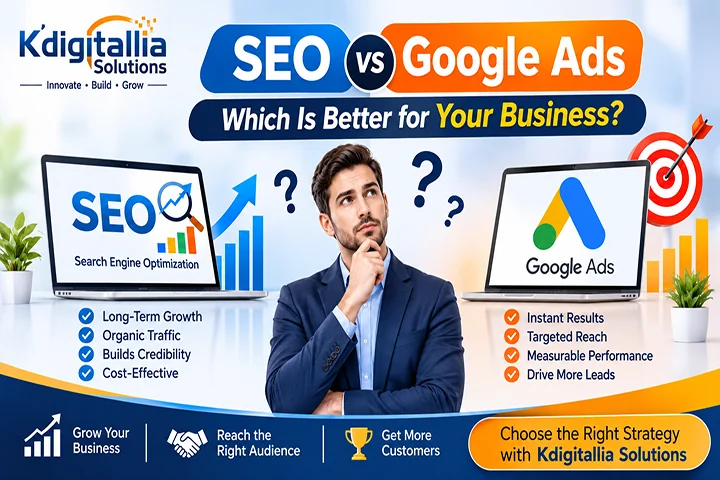
SEO vs Google Ads: Which Is Better for Your Business?
Why Every Small Business Needs a Professional Website
How to Increase Sales Through Social Media Marketing
How to Generate More Enquiries Through Google Ads
This type of content can attract relevant website visitors and establish your business as a knowledgeable service provider.
Effective content marketing formats
SEO-friendly blog articles
Informative videos and tutorials
Downloadable guides and e-books
Case studies and customer success stories
Industry reports and research
Infographics and educational social media posts
Always include relevant calls to action within your content so interested readers can contact your business, request a consultation, or explore your services.
7. Use Landing Pages to Convert More Visitors into Leads
A landing page is a dedicated webpage designed to encourage visitors to complete a specific action.
Instead of sending every visitor to your homepage, create separate landing pages for individual products, services, campaigns, or target audiences.
For example, a digital marketing company could create different landing pages for:
SEO Services
Google Ads Management
Social Media Marketing
Website Development
Mobile App Development
Digital Marketing for Real Estate Businesses
What makes a good landing page?
A high-converting landing page should contain:
A clear and compelling headline
A description of the service or offer
Benefits of choosing your business
Relevant images and supporting content
Customer testimonials or trust indicators
A simple enquiry form
A prominent WhatsApp or call button
A clear Call-to-Action
Avoid unnecessary distractions and complicated forms. Ask only for the information needed to qualify and contact the potential customer.
8. Use Email Marketing to Nurture Potential Customers
Not every person who visits your website or submits an enquiry is ready to purchase immediately.
Some customers may need additional information, time to compare service providers, or approval from their management team.
Email marketing helps businesses maintain communication with these prospects.
You can use email campaigns to share:
New product and service updates
Educational newsletters
Special offers and promotions
Case studies and success stories
Useful industry information
Follow-up messages for previous enquiries
For example, if someone requests information about your website development services but does not immediately proceed, you can send relevant portfolio examples, service details, and useful resources through an appropriate follow-up email sequence.
Always obtain appropriate consent and provide an easy way to unsubscribe from marketing emails.
9. Use WhatsApp Marketing for Faster Customer Communication
Customers increasingly prefer convenient communication channels when enquiring about products and services.
WhatsApp Business can help businesses respond to enquiries, share information, answer common questions, and maintain customer relationships.
Useful WhatsApp Business features include:
Business profiles
Automated greeting messages
Quick replies
Product and service catalogues
Labels for organising enquiries
Click-to-WhatsApp advertisements
Customer follow-up communication
For businesses receiving enquiries from multiple channels, integrating WhatsApp with a CRM or customised web portal can help organise conversations and improve enquiry management.
Use WhatsApp responsibly and communicate with customers who have agreed to receive messages.
10. Implement CRM and Lead Management to Improve Conversions
Generating leads is only one part of successful digital marketing.
If your business receives enquiries but fails to follow up, many potential customers may choose a competitor.
A Customer Relationship Management (CRM) system helps businesses organise and manage their sales pipeline.
How CRM improves lead management
Store customer contact information.
Track enquiries from different marketing channels.
Assign leads to sales representatives.
Record follow-up activities.
Monitor lead status and conversion progress.
Set reminders for pending enquiries.
Analyse sales team performance.
Identify the most effective lead generation campaigns.
For example, a business may receive enquiries through its website, Google Ads, Facebook campaigns, and WhatsApp.
A centralised lead management system can bring these enquiries together, helping the sales team respond efficiently.
Businesses with unique workflows can also benefit from customised CRM and web portal development rather than relying entirely on generic software.
11. Track Marketing Performance and Measure Lead Quality
An effective digital marketing strategy should be measured using meaningful business metrics.
Simply increasing website traffic or social media followers does not guarantee business growth.
You should monitor the following key performance indicators (KPIs):
| KPI | What it measures |
|---|---|
| Website Traffic | Number of visitors coming to your website |
| Conversion Rate | Percentage of visitors completing a desired action |
| Cost Per Lead (CPL) | Average marketing cost for generating one lead |
| Qualified Leads | Leads matching your target customer requirements |
| Lead-to-Customer Rate | Percentage of leads converted into customers |
| Customer Acquisition Cost (CAC) | Average cost of acquiring a customer |
| Return on Ad Spend (ROAS) | Revenue generated relative to advertising spend |
For example, Campaign A may generate 100 enquiries, while Campaign B generates only 40.
However, if Campaign B attracts customers with higher purchasing intent and produces more sales, it may be the more profitable campaign.
Focus on generating qualified and profitable leads rather than simply increasing enquiry volume.
12. Combine Multiple Digital Marketing Channels for Better Results
One marketing channel rarely delivers the best results for every business.
A more effective approach is to combine different digital marketing strategies according to your objectives, audience, and budget.
Consider the following example:
| Marketing Channel | Primary Objective |
|---|---|
| SEO | Generate long-term organic enquiries |
| Google Ads | Attract customers actively searching for services |
| Social Media | Build brand awareness and engagement |
| Content Marketing | Educate prospects and establish credibility |
| Email Marketing | Nurture and convert existing leads |
| WhatsApp Business | Improve enquiry communication |
| CRM Integration | Manage and track leads effectively |
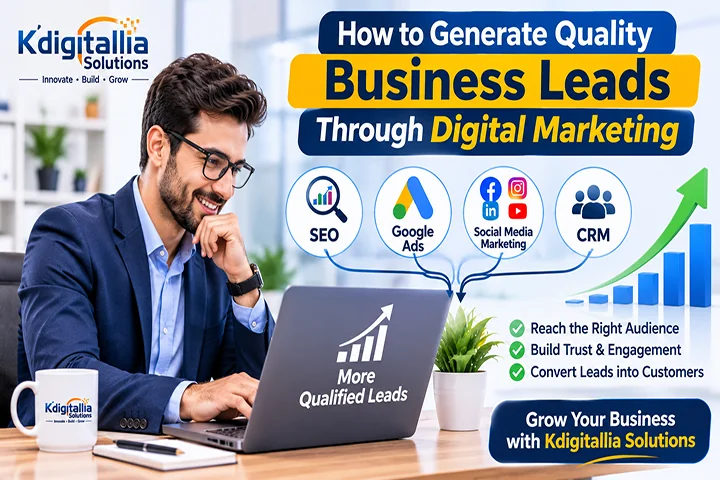
A business can use SEO to attract organic traffic, Google Ads to generate immediate enquiries, social media to build trust, and CRM to manage all incoming leads.
This integrated approach creates a more consistent customer acquisition process.
13. Common Digital Marketing Mistakes That Businesses Should Avoid
Even businesses investing significant money in digital marketing sometimes struggle to generate quality leads.
Some common mistakes include:
Targeting an audience that is too broad.
Choosing keywords without understanding search intent.
Running advertisements without conversion tracking.
Sending advertising traffic to irrelevant webpages.
Having complicated enquiry forms.
Ignoring mobile users.
Publishing promotional content without providing value.
Failing to respond to enquiries promptly.
Not following up with interested prospects.
Measuring success only through clicks and impressions.
Ignoring lead quality and actual sales performance.
Avoiding these mistakes can improve campaign efficiency and help businesses get more value from their marketing investment.
How Kdigitallia Solutions Helps Businesses Generate Quality Leads
At Kdigitallia Solutions, we understand that every business has different marketing objectives, customer requirements, and growth challenges.
Our goal is to help businesses build a stronger digital presence and create effective systems for attracting and converting potential customers.
We offer a range of digital services to support business growth.
1. Professional Website and Web Portal Development
We develop responsive, professional websites and customised web portals designed around your business requirements.
Our solutions can include enquiry forms, customer dashboards, booking systems, CRM integrations, and customised business workflows.
2. Search Engine Optimisation (SEO)
We help businesses improve their organic search visibility through keyword research, on-page SEO, technical optimisation, content strategy, and local SEO.
3. Google Ads and Paid Advertising
We help businesses reach relevant audiences through targeted advertising campaigns, with a focus on enquiry generation, conversion tracking, and campaign optimisation.
4. Social Media Marketing
We help businesses strengthen their social media presence through content planning, creative campaigns, audience engagement, and promotional strategies.
5. Digital Marketing and Advertising
We develop digital marketing strategies based on your business goals, target audience, industry, and marketing budget.
6. Customised CRM and Business Automation
We can help businesses streamline enquiry management, customer communication, lead tracking, and repetitive business processes through customised web-based solutions.
Our approach combines technology, marketing, and business understanding to help organisations build a more effective digital growth strategy.